
After helping hundreds of buyers and sellers, we've learned that one of the biggest mistakes homeowners make is doing either too much or too little to prepare their property for sale. Some spend thousands on renovations they'll never fully recover; others overlook inexpensive repairs that could make their home more appealing. The key is knowing the difference. Whether you're selling in Harrisburg, Camp Hill, Mechanicsburg, Carlisle, Hershey, or Lancaster, here's how we guide prep and staging so every dollar you spend comes back at closing.
Don't renovate just because you're selling.
The first question we discuss with homeowners across Central Pennsylvania is which home improvements are actually worth making before a sale. Let's say you're considering spending $20,000 updating your kitchen in your Camp Hill or Mechanicsburg home. That's a significant investment, especially if you're planning to move in the next few months. But what if those improvements only increase your home's market value by $10,000? You've essentially spent $20,000 to gain $10,000 in value. The same principle applies to replacing windows, remodeling bathrooms, and making other expensive home improvements before selling. That doesn't mean renovations are always a bad idea — it means we evaluate the property, the comparable sales in your Central PA neighborhood, and current market conditions before making those decisions.
Small repairs can make a big difference.
While we often advise against unnecessary renovations, we're a big believer in taking care of smaller maintenance issues. Things like chipped paint, damaged drywall, loose fixtures, and minor plumbing repairs can affect how buyers perceive a home. Individually, these may seem insignificant. But when buyers walk through a property and notice several small issues, they may begin wondering what else hasn't been maintained. Before listing, we walk through the property and evaluate what needs attention — what will help the home show better and what probably won't justify the expense. It's not about making the home perfect; it's about making smart decisions.
Decluttering is one of the best places to start.
One recommendation we frequently make to sellers is also one of the simplest: start packing early. If you've lived in your home for years, chances are you've accumulated furniture, decorations, and belongings you don't use every day. Our suggestion is to start putting those items away. If you're going to need them in your next home, consider putting them in storage; if you no longer use them, this might be a good opportunity to get rid of them. When we prepare a property for listing, we walk through every room and think about how it's going to appear to potential buyers. Sometimes that means rearranging furniture; sometimes it means removing a few pieces altogether. We want buyers to notice the space, the layout, and the features of the home — and often, that doesn't require spending much money.
The dollar-aware prep checklist.
We give every seller a prioritized checklist that separates improvements into three tiers. Tier one — almost always worth it: decluttering and deep cleaning, fresh neutral paint in any bold or dated rooms, replacing burned-out bulbs with bright, consistent-temperature LEDs, tightening loose fixtures and hardware, and addressing obvious minor repairs (a sticking door, a leaky faucet, cracked caulk). These items cost little and return many times their cost in buyer perception. Tier two — often worth it: refreshing landscaping and curb appeal (mulch, trimmed shrubs, a clean entry), updating lighting fixtures that read as dated, and addressing any odors (pet, smoke, mildew). Tier three — rarely worth it before selling: major kitchen or bath remodels, new windows, new roof (unless the existing roof is failing and will kill the sale), and high-end finishes. We'll help you decide which tier each item falls into for your specific home.
Staging: what it is and what it isn't.
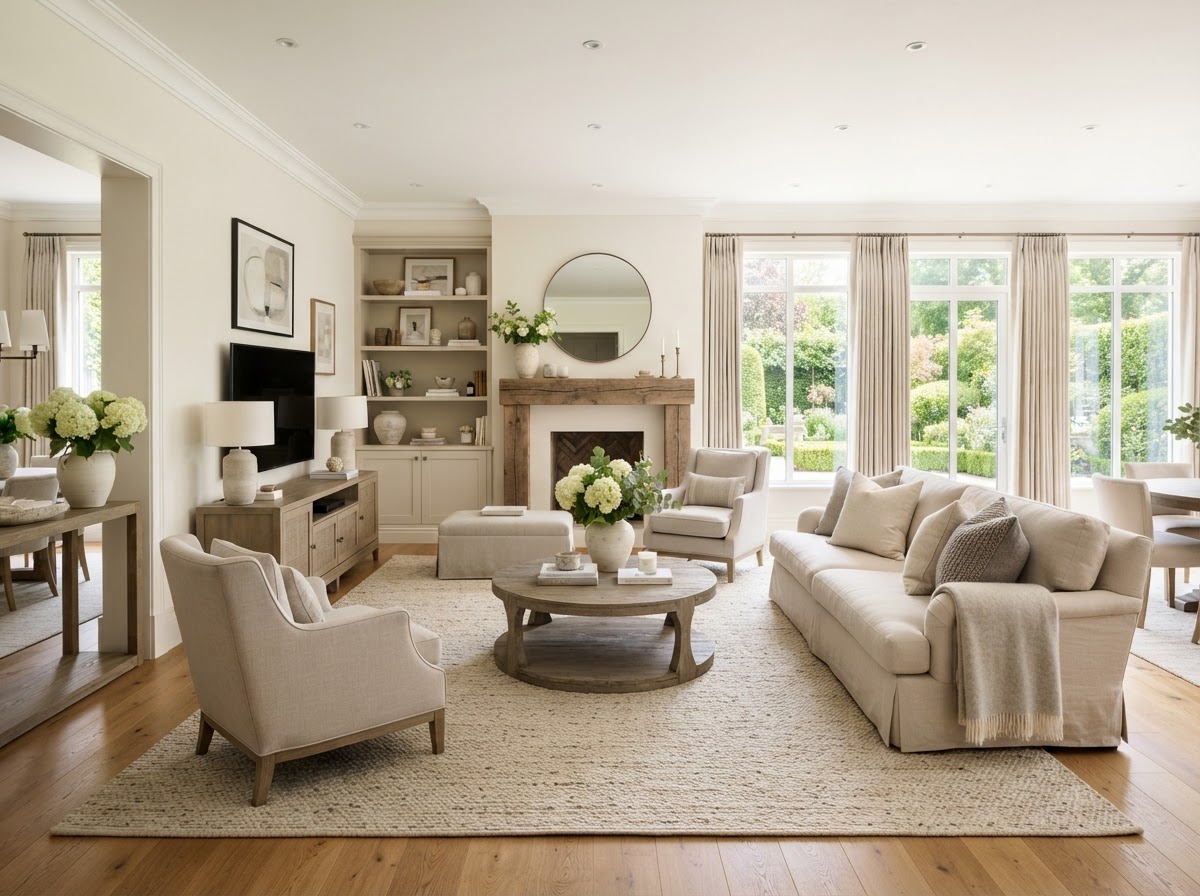
Staging isn't about filling your home with expensive furniture — it's about presenting each room's purpose, scale, and flow so buyers can picture themselves living there. For an occupied home, staging often means editing: removing excess furniture, neutralizing personal items (family photos, collections, political or religious decor), and arranging what remains to highlight the room's best features. For a vacant home, we may bring in key furniture pieces to give the space scale and warmth — an empty room reads smaller than a furnished one. We work with professional stagers when the investment is justified, and we guide DIY staging when it isn't. The goal is always the same: help buyers see the home, not your stuff.
Curb appeal is the first impression — and it's online.
Most buyers form their first impression from the listing photos before they ever drive by. That means curb appeal matters twice: once in the photos and once in person. A manicured lawn, fresh mulch, trimmed shrubs, a clean walkway, a painted front door, and a welcoming entry set the tone for the entire showing. A buyer who pulls up to a tired exterior has already formed a negative opinion before stepping inside. We walk the exterior with you and identify the quick, inexpensive fixes that transform first impressions.
Lighting is the most underappreciated prep item.
A dark home reads smaller, older, and less inviting — and it photographs poorly. Before any showing or photo shoot, we ensure every room is well-lit: replace dim or mismatched bulbs, open all blinds and curtains, turn on every light, and add lamps to dark corners. For photo day, we may even bring in supplemental lighting. The difference in how a bright, well-lit home shows versus a dim one is dramatic, and the cost is a trip to the hardware store.
Address odors honestly.
Pet, smoke, and mildew odors are deal-breakers for many buyers — and they're often invisible to the homeowner who lives with them. We'll be honest with you if we notice an odor, because buyers will, and it's far better to address it before listing than after a showing goes poorly. Solutions range from deep cleaning and replacing carpet to addressing the source (a damp basement, a pet area). We've seen homes sit unsold solely because of an odor the seller couldn't smell — and sell quickly once it was addressed.
Scenario: the over-improver.
A seller plans to spend $30,000 on a kitchen remodel before listing because 'buyers want updated kitchens.' The comps show that updated kitchens in the neighborhood add roughly $15,000–$20,000 in value — meaning the seller would lose $10,000–$15,000 on the remodel. We redirect the investment: $3,000 in paint, lighting, hardware, and decluttering, plus professional staging of the existing kitchen, achieves 80% of the visual impact for a fraction of the cost. The home sells for the same price it would have with the full remodel, and the seller keeps $12,000 more in equity.
Scenario: the under-preparer.
A seller wants to list 'as-is' with no prep because 'buyers can see past it.' The home has bold purple walls, cluttered rooms, dim lighting, and a leaky faucet. The listing photos underperform, showings are sparse, and the first offer comes in $15,000 under asking with a list of repair demands. A week of $1,500 in prep — neutral paint, decluttering, lighting, and the faucet repair — would have produced stronger photos, more showings, and a cleaner offer. The 'as-is' approach cost the seller far more than the prep would have.
The prep timeline.
Prep takes longer than sellers expect. Decluttering and packing can take a week or more for a lived-in home. Painting takes a few days. Sourcing and scheduling a stager, photographer, and any contractors takes lead time. We build a prep timeline backward from the target launch date, so everything is ready for a single, strong launch rather than a piecemeal listing that goes live before it's ready. A home that launches fully prepped gets its strongest first-week exposure; one that launches half-prepped wastes that window. Ready to prep your home the smart way? Aaron Rissinger and Josh Krevsky — Living in Central PA Team | Iron Valley Real Estate of Central PA — 717-REALTOR (717-732-5867) — your Central PA real estate agents for home staging and prep across Harrisburg, Camp Hill, Mechanicsburg, Carlisle, Hershey, Lancaster, and the 717 area.
Key Takeaways
- Don't renovate just because you're selling — evaluate each improvement against the comps
- Small repairs (paint, fixtures, drywall) pay back many times their cost in buyer perception
- Decluttering is the highest-ROI prep item and costs almost nothing
- A three-tier prep checklist separates what pays from what doesn't
- Staging edits a room's purpose, scale, and flow — it's not about expensive furniture
- Curb appeal matters twice — in the photos and at the curb
- Lighting is the most underappreciated prep item; a bright home shows and photographs better
- Address odors honestly before listing, not after a showing goes poorly
- Build a prep timeline backward from the launch date for one strong debut
- Work with a Central PA real estate agent who knows home staging
- Stage your home to sell in Harrisburg, Camp Hill, Mechanicsburg, Carlisle & Hershey