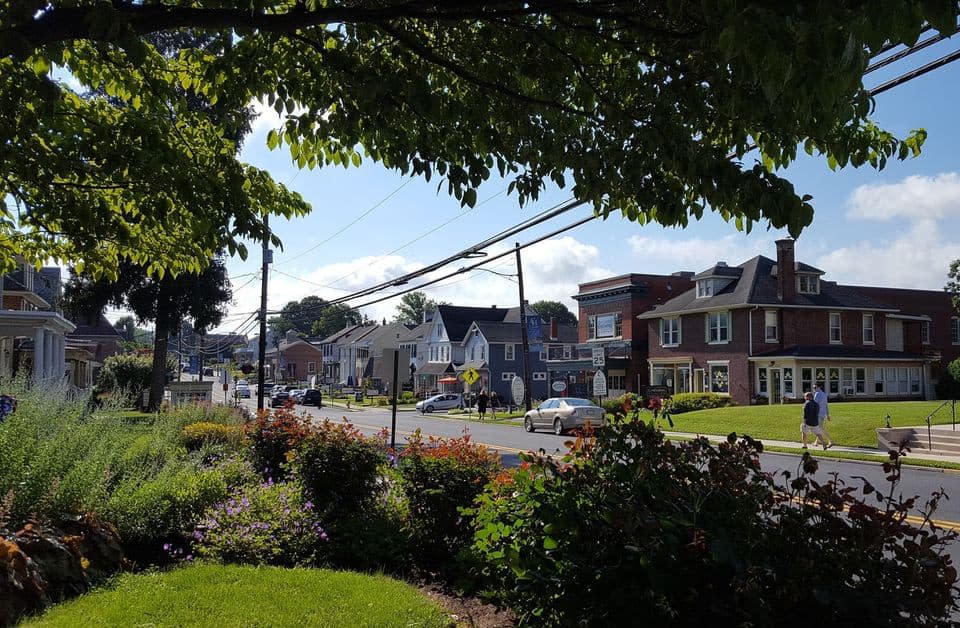
Downtown Camp Hill along Market Street — featuring walkable local boutiques, artisan cafes, and vibrant borough streetscapes.
Camp Hill is one of the most sought-after boroughs on the West Shore — and one of the tightest markets. Top-rated schools, a walkable downtown, and a compact footprint mean homes move fast. Here's how to compete in 2026, with the latest statistics on pricing, inventory, days on market, and demographics to help you make a confident, informed offer.
Camp Hill Market Snapshot — September 2026.
According to recent data compiled from Realtor.com, Redfin, and Zillow, Camp Hill's median sold price sits in the $310,000–$340,000 range, with a median listing price typically running $50,000–$75,000 higher than the median sold price as sellers test the upper end of the market. The median asking price per square foot is approximately $210–$225, reflecting the borough's premium for walkable, tree-lined streets and top-rated schools. Active inventory in the Camp Hill market generally hovers between 25 and 45 listings at any given time — a remarkably small pool for a community this desirable — and the median days on market runs roughly 25–35 days for active listings, though well-priced, move-in-ready homes routinely go under contract in under two weeks.
Year-over-year, Camp Hill home values have remained resilient.
Redfin reported a median sale price increase of roughly 2–4% compared with the same period a year earlier, while Zillow's Home Value Index estimated a typical Camp Hill home value of approximately $320,000–$340,000 as of late 2026, up roughly 1–2% year over year. The average sale-to-list price ratio sits near 99%, meaning homes are selling very close to asking price — but not always above it. Roughly 35–40% of sales close above list, 35–40% close below, and the remainder close at approximately the asking price. That distribution tells you Camp Hill is a competitive seller-leaning market, but buyers who are patient and well-prepared can still negotiate, especially on homes that have been listed longer than the median.
Start with a strong pre-approval, not a ballpark estimate.
In Camp Hill, sellers expect to see a verified approval letter with the offer, and a weak pre-approval is the fastest way to lose a multiple-offer situation before it starts. With roughly 25–45 active listings and a buyer pool anchored by families targeting the Camp Hill School District, competition for updated homes in the $300,000–$400,000 band is consistently strong. A verified pre-approval — not a pre-qualification — signals to a seller that your financing is underwritten and your lender has already verified income, assets, and credit.
Know the borough's housing stock.
Camp Hill is dominated by Colonials, American Foursquares, Cape Cods, and mid-century ranch homes on tree-lined streets, with a median home age of roughly 60–70 years. Lot sizes are modest — typically 0.15 to 0.25 acres — which is part of what makes the borough so walkable. Understanding what's typical for the price band you're targeting helps you spot value and avoid overpaying for a home that's been cosmetically flipped. A genuine 2026 comp analysis should account for square footage, finished basement space, garage presence, roof and mechanical age, and proximity to the borough's walkable core along Market Street and 32nd Street.
Move quickly but don't skip the inspection.
The best Camp Hill listings go under contract in days, sometimes hours. We tour new listings the day they hit and write clean offers — but we always protect you with inspection contingencies structured to keep the deal moving without exposing you to costly surprises. In a market where the median home is 60+ years old, an inspection is especially important: older electrical systems, galvanized or lead water lines, knob-and-tube wiring in pre-1950 homes, aging roofs, and original windows are all common findings that can mean thousands in near-term repairs. A buyer who waives inspection to win an offer can easily inherit a $15,000–$30,000 repair list.
Price per square foot tells only part of the story.
At roughly $210–$225 per square foot, Camp Hill commands a premium over many surrounding West Shore communities — but a finished basement, updated mechanicals, a two-car garage, and proximity to the borough's walkable core all add value that a raw $/sqft comparison misses. We'll show you the real comps, not just the averages. A 1,800 sq ft Colonial with a finished basement and updated HVAC is not comparable to a 1,800 sq ft home with an unfinished basement and a 30-year-old furnace, even if the price-per-square-foot looks identical on paper.
Camp Hill Demographics: Who Lives Here.
According to the U.S. Census Bureau's 2020–2024 American Community Survey, Camp Hill Borough has an estimated population of approximately 8,000–8,200 residents, a median age of roughly 41–43 years, and a median household income of approximately $115,761 — among the highest of any borough in the Harrisburg region. The owner-occupied housing rate is approximately 70–72%, the average household size is roughly 2.3–2.4 persons, and roughly 55–60% of residents age 25 and older hold a bachelor's degree or higher, well above both the state and national averages. These demographics — high income, high education, and strong homeownership — are a primary driver of Camp Hill's consistently strong home values and tight inventory.
The Camp Hill School District Advantage.
Camp Hill School District is consistently ranked among the top districts in the region, with small class sizes, strong PSSA proficiency scores, and a close-knit community feel that comes from being a single-borough district. This is the single biggest driver of home values in the borough — buyers routinely accept a higher price per square foot specifically to land in the district, and homes within Camp Hill SD boundaries consistently outperform comparable homes in neighboring districts on resale. For families relocating to Central PA with school-age children, the district is often the deciding factor, and it's a major reason Camp Hill inventory stays so tight: families move in and rarely move out.
Property Taxes in Camp Hill.
Camp Hill Borough's total millage (county + municipal + school district) tends to run higher than surrounding townships like Hampden or Lower Allen because of the borough's small commercial tax base — most of the tax burden falls on residential properties. A $350,000 home in Camp Hill Borough may carry an annual property tax bill of roughly $6,000–$7,500, compared with $4,500–$5,800 for a similarly priced home in Hampden Township. Before making an offer, always verify the actual property tax bill, assessed value, and any homestead exemptions — and factor the monthly tax cost into your affordability calculation, not just the mortgage payment.
Neighborhood Nuances Within the Borough.
Camp Hill is compact — roughly 2.2 square miles — but it has distinct pockets. The streets closest to Market Street and the downtown corridor offer the most walkable lifestyle, with shops, restaurants, and the borough library within a short stroll. Streets further west toward 32nd Street and the East Pennsboro border offer slightly larger lots and a quieter residential feel. The area near Siebert Park and the high school has a strong family-oriented character with easy access to recreation. Each pocket has slightly different price dynamics, so a borough-wide median only tells part of the story — the right comp is a home on a similar street with similar lot size and proximity to amenities.
New Construction vs.
Resale in Camp Hill. True new construction is rare in Camp Hill because the borough is largely built out, so most buyers are purchasing resale homes — many dating to the 1940s–1970s. The occasional tear-down or infill build does come to market, typically priced at a premium ($450,000–$600,000+). For most buyers, the decision is between a well-maintained original home and a renovated or flipped property. Renovated homes command a premium but can save you the disruption of living through a project; original homes offer more negotiation room but may need $20,000–$50,000 in updates to mechanicals, kitchen, baths, and windows. We help buyers weigh the total cost — purchase price plus anticipated improvements — rather than just the sticker price.
What the 2026 Camp Hill Market Means for You.
For buyers, the current market rewards preparation. Get preapproved before you tour, define your must-haves versus nice-to-haves, and be ready to move quickly when the right home lists — but don't let urgency override due diligence. For sellers, strategic pricing, strong presentation, and professional photography still win, because even in a tight market, buyers can compare your home to every other listing online. The most important takeaway: Camp Hill's strength is consistent, but it's not uniform. The right strategy depends on your price band, your timeline, and the specific street you're targeting — and that's where local, neighborhood-level expertise makes the difference.
Key Takeaways
- Median sold price ~$310K–$340K; median $/sqft ~$210–$225 (2026)
- Active inventory is tight — typically only 25–45 listings at a time
- Median days on market ~25–35 days; well-priced homes go in under 2 weeks
- Sale-to-list ratio ~99%; ~35–40% of sales close above list price
- Lead with a verified pre-approval, not a pre-qualification
- Median home age ~60–70 years — never skip the inspection
- Camp Hill SD is the #1 driver of home values and tight inventory
- Median household income ~$115,761; ~55–60% hold a bachelor's+
- Property taxes run higher than surrounding townships — verify before offering
- Compare total cost (price + improvements), not just sticker price
- Look past $/sqft to the real comps — finished basement, mechanicals, garage