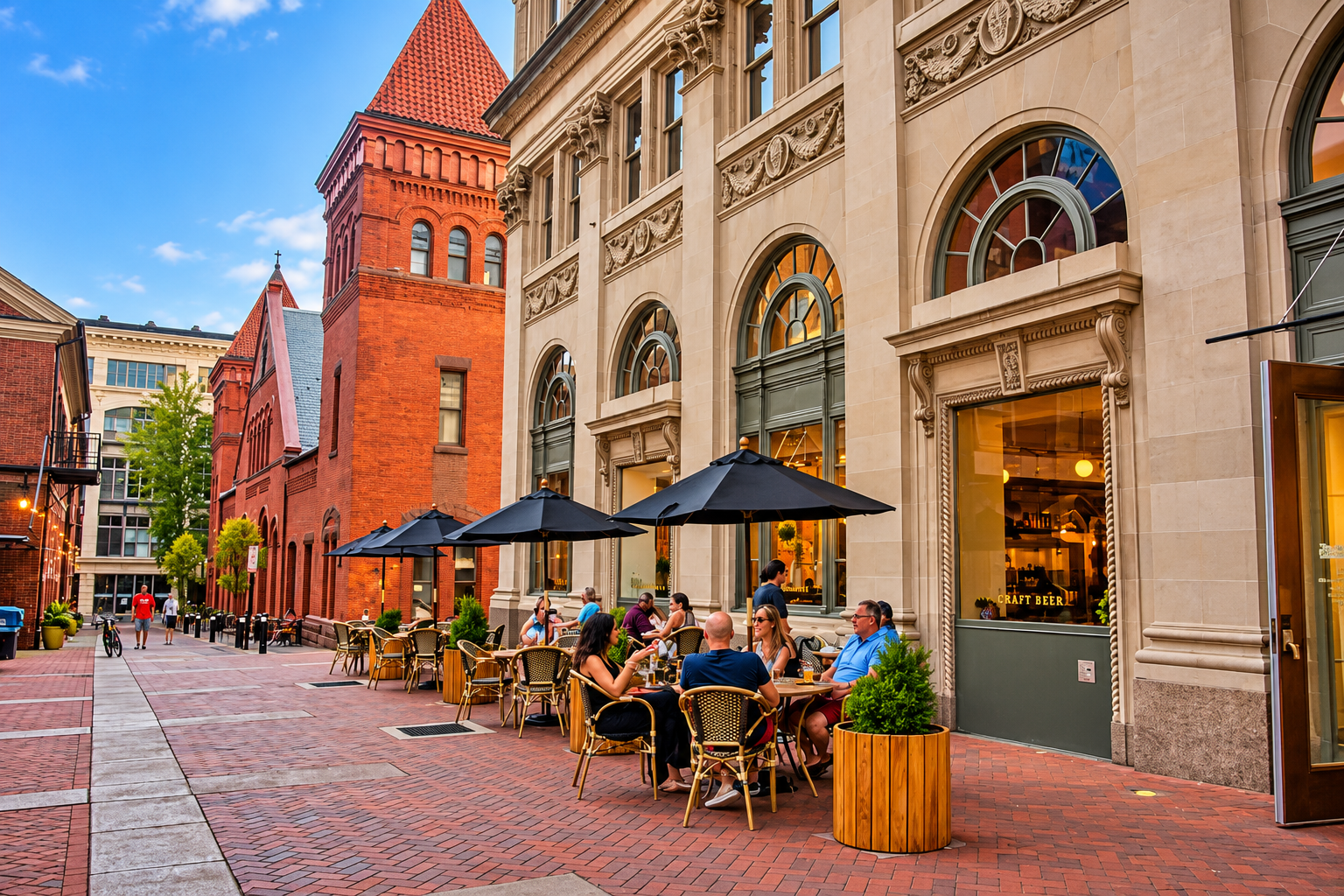
Outdoor dining along historic brick alleyways in downtown Lancaster — vibrant craft dining and walkable small-city energy.
Lancaster is one of Pennsylvania's oldest and most dynamic small cities — a place where three centuries of history sit alongside a genuinely thriving arts scene, a nationally recognized food culture, and some of the most productive farmland in the country. Here's what life and the real estate market actually look like in Lancaster in 2026, with the latest statistics on pricing, inventory, demographics, and the neighborhoods that shape value.
Lancaster at a glance.
Plotted in 1730 and chartered as a borough in 1741, Lancaster briefly served as the capital of the United States in 1777 when the Continental Congress fled here from Philadelphia, and it remained the capital of Pennsylvania from 1799 until 1812, when the seat of government moved to Harrisburg. According to the U.S. Census Bureau's 2020–2024 American Community Survey, the City of Lancaster has an estimated population of approximately 57,000–58,000 residents, a median age of roughly 31–33 years, and a median household income of approximately $47,000–$50,000 — lower than the surrounding suburbs, reflecting the city's larger renter population and urban character. That early prominence left behind a remarkably intact historic core that still anchors city life today.
Central Market — the heart of the city.
The heart of Lancaster is the storied Central Market, the oldest continuously operating publicly owned farmers market in the country, dating to the 1730s and housed in its landmark 1889 Romanesque Revival hall. Shoppers and chefs from across the county gather there on Tuesdays, Fridays, and Saturdays for local produce, Amish-grown vegetables, baked goods, and prepared foods, and the market spills out into the surrounding blocks of the revitalized downtown. For residents, Central Market is more than a tourist attraction — it's a weekly ritual that defines the rhythm of city life.
Gallery Row and the arts district.
Just steps from the market, Gallery Row along North Prince and Queen Streets anchors the city's celebrated arts district — a dense cluster of independent galleries, studios, and performance spaces — joined by the Fulton Opera House (a National Historic Landmark named for steamboat inventor Robert Fulton, a native son), the Demuth Museum, the Lancaster Museum of Art, and a year-round calendar of First Friday openings and festivals. The Pennsylvania College of Art & Design contributes to the creative workforce, and the city's growing tech and startup scene has earned it national notice as a rising small-city hub.
A nationally recognized food scene.
The dining scene has become a genuine regional draw, with award-winning restaurants, brewpubs, and coffee roasters filling the old warehouse and wholesale buildings of the North Prince and North Queen corridor. Lancaster has been recognized by national publications as one of the country's standout small-city food destinations, and the farm-to-table movement here is grounded in the surrounding Lancaster County farmland — some of the most productive agricultural land in the United States. For residents, that means year-round access to locally grown food, craft beer, and chef-driven dining within a walkable downtown.
Education and healthcare anchors.
Education and healthcare anchor the city's economy and daily life. Franklin & Marshall College, founded in 1787 and one of the oldest colleges in the country, sits on its hillside campus overlooking downtown, while Lancaster Theological Seminary, the Pennsylvania College of Art & Design, and Thaddeus Stevens College of Technology round out the higher-ed landscape. Penn Medicine Lancaster General Hospital is one of the region's major employers and a top-rated teaching hospital, providing nationally ranked cardiovascular, oncological, and trauma care right in the heart of town.
Lancaster's housing market in 2026.
According to recent data compiled from Realtor.com, Redfin, and Zillow, Lancaster City's median sold price sits in the $195,000–$230,000 range, with a median listing price typically running somewhat higher. The median asking price per square foot is approximately $135–$150, reflecting the city's mix of affordable historic rowhomes and higher-end single-family homes. Active inventory in the Lancaster market generally hovers between 60 and 120 listings at any given time, and the median days on market runs roughly 26–40 days for active listings, though well-priced, move-in-ready homes in the most desirable neighborhoods routinely go under contract faster.
Year-over-year, Lancaster home values have shown steady appreciation.
Zillow's Home Value Index has reported year-over-year gains in the mid-single digits, supported by the city's growing desirability as a small-city destination, the strength of the healthcare and education employment base, and limited new construction within the city limits. The average sale-to-list price ratio sits near 98–99%, and roughly 30–35% of sales close above list — a competitive but not frenzied market where well-prepared buyers can still find value, especially in the city's more affordable neighborhoods.
Neighborhoods within Lancaster City.
Lancaster's residential landscape is wonderfully diverse. The downtown and Chestnut Hill districts offer historic Federal and Victorian brick rowhouses, often in the $175,000–$325,000 range, within walking distance of Central Market, Gallery Row, and the restaurants. The West End and School Lane Hills offer gracious mid-century and early-20th-century single-family homes on larger lots, frequently in the $350,000–$650,000+ range. Each pocket has distinct price dynamics, so a city-wide median only tells part of the story — the right comp is a home on a similar street with similar character and proximity to amenities.
The School District of Lancaster.
Lancaster is served by the School District of Lancaster, the second-largest public district in the county, with J.P. McCaskey High School as its flagship. The city is also served by Lancaster Catholic High School, Veritas Academy, and several respected parochial and charter schools. As with every Central PA community, buyers relocating with school-age children should evaluate the full range of public, private, and charter options and verify school assignment by street address before purchasing.
Property taxes in Lancaster City.
Lancaster City's total millage (county + municipal + school district) tends to run higher than the surrounding suburban townships because of the city's larger municipal service footprint and smaller commercial tax base relative to its residential population. A $250,000 home in Lancaster City may carry an annual property tax bill of roughly $5,500–$7,500, compared with $4,000–$5,500 for a similarly priced home in the surrounding Lancaster County suburbs. Always verify the actual property tax bill before making an offer, and factor the monthly tax cost into your affordability calculation.
Commuting from Lancaster.
Lancaster is approximately 38 miles southeast of Harrisburg, an easy 45–50 minute drive via PA Route 283 or US Route 30. Amtrak Keystone Service connects Lancaster Station directly to Harrisburg (about 45 minutes) and to Philadelphia (about 70 minutes), making it a genuine option for commuters who prefer rail. For buyers who split time between Lancaster and the broader capital region, the drive is short enough that Lancaster's small-city lifestyle is accessible without giving up access to Harrisburg employment.
The Lancaster Countryside.
Surrounding it all is the Lancaster Countryside — the iconic Amish and Pennsylvania Dutch farmland, covered bridges, and rolling fields that draw millions of visitors a year and remain the defining backdrop of life in the city. For residents, that means world-class access to farm stands, farmers markets, scenic drives, and a rural character that's increasingly rare this close to a vibrant small city. The Conestoga River, county parks, and the Lancaster County Heritage Trail extend the recreation network beyond the city limits.
What the 2026 Lancaster market means for you.
For buyers, Lancaster offers a rare combination — walkable urban living, a nationally recognized food and arts scene, strong healthcare and education employment, and the surrounding Lancaster County countryside — at price points that remain more affordable than many comparable small cities on the East Coast. Get preapproved before you tour, define your must-haves, and be ready to move on well-priced homes in the most desirable neighborhoods. For sellers, strategic pricing, strong presentation, and professional photography still win, because the city's growing desirability means buyers are comparing your home to a national field of small-city destinations. The most important takeaway: Lancaster's appeal is broad, but its neighborhoods are distinct — the right strategy depends on your price band, your timeline, and the specific street you're targeting.
Key Takeaways
- Median sold price ~$195K–$230K; median $/sqft ~$135–$150 (2026)
- Central Market — oldest continuously operated public farmers market in the U.S.
- Gallery Row arts district, Fulton Opera House, and First Friday celebrations
- Franklin & Marshall College (est. 1787) & Penn Medicine Lancaster General Hospital
- Median days on market ~26–40 days; inventory typically 60–120 listings
- Sale-to-list ratio ~98–99%; ~30–35% of sales close above list
- School District of Lancaster (McCaskey HS) — verify assignment by address
- Property taxes run higher than surrounding Lancaster County suburbs
- 45–50 minute commute to Harrisburg; Amtrak Keystone Service available
- Surrounding Amish farmland — some of the most productive in the U.S.
- Nationally recognized small-city food and arts destination