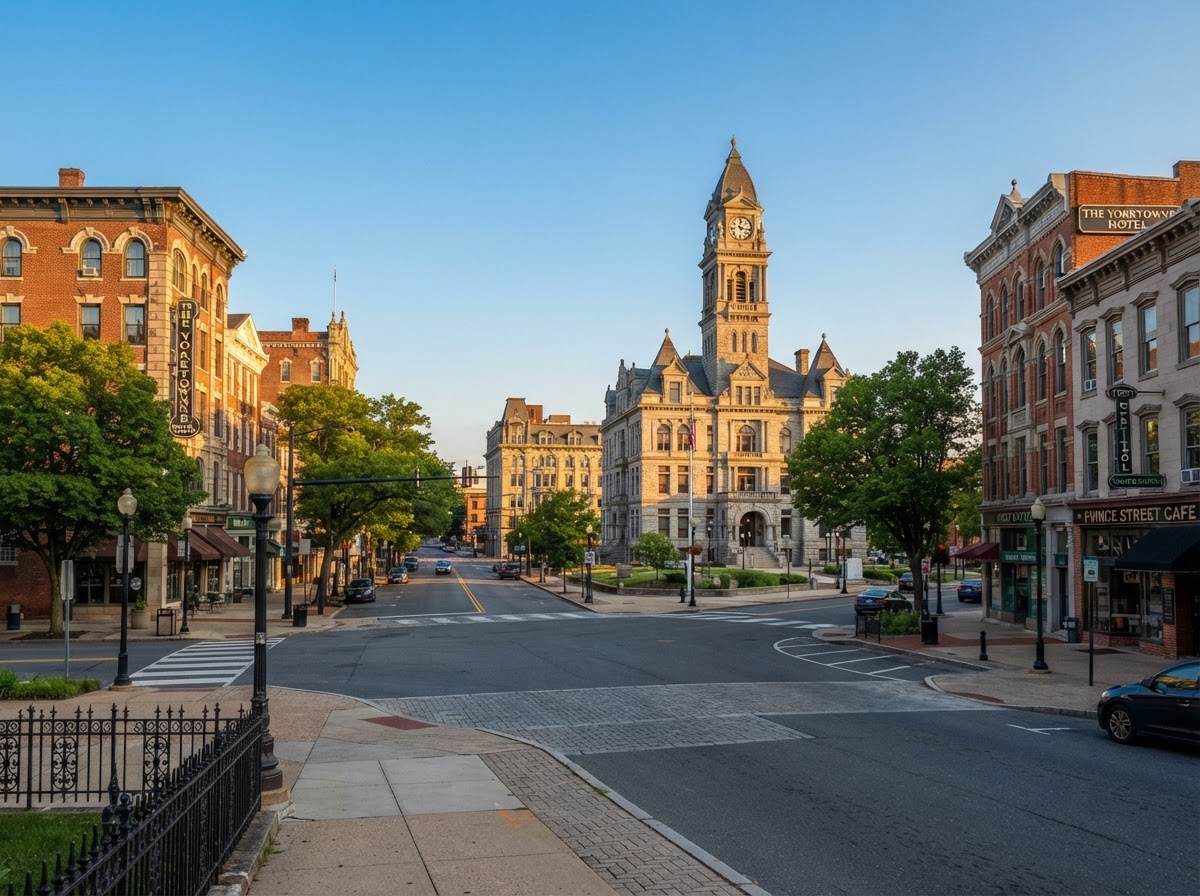
Continental Square in downtown York — the historic heart of the first capital of the United States and the York County seat.
York is the historic county seat of York County and one of the most historically significant small cities in Pennsylvania — famously serving as the first capital of the United States when the Continental Congress met there in 1777–1778 and adopted the Articles of Confederation. Here's what life and the real estate market actually look like in York in 2026, with the latest statistics on pricing, inventory, demographics, and the neighborhoods that shape value.
York at a glance.
Located in the center of York County along the I-83 corridor, York City is the county seat and the cultural and economic heart of the region. According to the U.S. Census Bureau's 2020–2024 American Community Survey, the City of York has an estimated population of approximately 44,000–45,000 residents, a median age of roughly 33–35 years, and a median household income of approximately $40,000–$44,000 — lower than the surrounding York County suburbs, reflecting the city's larger renter population and urban character. The city's compact, walkable downtown grid centers on Continental Square, the historic heart of York, surrounded by restored brick and stone civic buildings and the York County Courthouse.
The first capital of the United States.
York's historic significance is unmatched in the 717 area code. The city served as the first capital of the United States when the Continental Congress met there from September 1777 to June 1778, having fled Philadelphia ahead of the British occupation. It was in York that the Continental Congress adopted the Articles of Confederation — the nation's first governing framework — earning the city its enduring nickname as the nation's first capital. That history is preserved in the city's historic sites, the Colonial Court House replica, and the community's identity, and it gives York a genuine sense of place that most towns its size can't claim.
A revitalizing downtown.
York's downtown has seen steady reinvestment in recent years, with a growing cluster of local restaurants, breweries, galleries, and shops filling the restored brick buildings around Continental Square. The York County Heritage Rail Trail — a 21-mile paved trail running from downtown York to the Maryland line — begins downtown and anchors the city's recreation network, connecting neighborhoods to the broader county trail system. The Appell Center for the Performing Arts, the York Central Market House (a historic farmers market dating to the 1800s), and a year-round calendar of festivals and First Friday events keep the downtown lively in every season.
The York County Heritage Rail Trail.
The Heritage Rail Trail is one of York's signature lifestyle amenities. The 21-mile paved trail runs from downtown York south to the Maryland line, where it connects to the Torrey C. Brown Rail Trail for an additional 20 miles into northern Maryland. It passes through the Hanover area, small towns, and rural countryside, and it's used year-round by cyclists, runners, and walkers. For residents, the trail is a genuine quality-of-life feature that connects the city to the broader county without a car.
York's housing market in 2026.
According to recent data compiled from Realtor.com, Redfin, and Zillow, York City's median sold price sits in the $150,000–$185,000 range, with a median listing price typically running somewhat higher. The median asking price per square foot is approximately $110–$135, reflecting the city's mix of affordable historic rowhomes and single-family homes. Active inventory in the York market generally hovers between 80 and 150 listings at any given time, and the median days on market runs roughly 30–45 days for active listings, though well-priced, move-in-ready homes in the most desirable neighborhoods routinely go under contract faster.
Year-over-year, York home values have shown modest appreciation.
Redfin and Zillow have reported year-over-year gains in the low single digits, supported by the city's affordability relative to the rest of the Harrisburg-Carlisle metro and a steady base of buyers — including state government commuters, healthcare workers, and buyers priced out of the Cumberland and Dauphin county suburbs. The average sale-to-list price ratio sits near 97–99%, and roughly 25–30% of sales close above list — a market where well-prepared buyers can find genuine value, especially in the city's more affordable neighborhoods and on homes that have been listed longer than the median.
Neighborhoods within York City.
York's residential neighborhoods are rich with historic character. The Historic District features grand Victorian homes and restored brick rowhouses within walking distance of Continental Square, often in the $200,000–$475,000+ range for well-preserved properties. The surrounding wards offer more affordable historic rowhomes and single-family homes, frequently in the $150,000–$250,000 range. The broader York County suburbs — including Dallastown, Central York, Red Lion, and Springettsbury Township — offer newer construction, larger lots, and suburban subdivisions at a range of price points, with the surrounding school systems (Dallastown, Central York, Red Lion) serving as a steady draw for families.
The York City School District.
York City is served by the York City School District, with William Penn Senior High School as its flagship. The surrounding suburban townships are served by the broader York County school systems, including Dallastown, Central York, and Red Lion — all of which are well-regarded. As with every Central PA community, a York mailing address doesn't guarantee a school assignment — buyers should verify the assigned district by street address before purchasing, especially when comparing city and suburban properties.
Property taxes in York City.
York City's total millage (county + municipal + school district) tends to run higher than the surrounding York County townships because of the city's larger municipal service footprint. A $200,000 home in York City may carry an annual property tax bill of roughly $5,000–$7,000, compared with $3,500–$5,000 for a similarly priced home in the surrounding York County suburbs. Always verify the actual property tax bill, assessed value, and any homestead exemptions before making an offer, and factor the monthly tax cost into your affordability calculation, not just the mortgage payment.
Employment and the local economy.
York's economy is anchored by a diversified base that includes manufacturing, healthcare, education, retail, and professional services. WellSpan Health is one of the region's largest employers, with York Hospital and a network of outpatient facilities throughout the county. The city's manufacturing heritage — including Harley-Davidson's Vehicle Operations facility just west of town — continues to provide skilled-trades employment, while the growing downtown revitalization has brought new retail, hospitality, and professional service jobs to the city core. The unemployment rate in York County has historically tracked near the national average, hovering around 3.5–4.5% in recent reporting periods.
Commuting from York.
York's location along the I-83 corridor is a genuine practical advantage. The commute into downtown Harrisburg typically runs 35 minutes via I-83 north, and the run to Baltimore is roughly 60 minutes south on I-83 — making York one of the few Central PA communities with easy access to two major employment markets. For buyers who work in the Harrisburg or York County employment corridors, the city's location puts both within reach, and the Amtrak station in nearby Lancaster provides rail access to Philadelphia and Harrisburg for longer trips.
Recreation and lifestyle.
York offers a quieter, more historic pace of life than the Cumberland and Dauphin county suburbs, with genuine walkability in the downtown core, the Heritage Rail Trail, the Colonial Court House replica, and easy access to Codorus State Park and Lake Marburg (just west of the city), Rocky Ridge County Park, and the Appalachian Trail at Pine Grove Furnace State Park. The Appell Center for the Performing Arts, local breweries, and a growing restaurant scene give residents year-round options without leaving town. For buyers who value history, walkability, and affordability — and who want easy access to both Harrisburg and Baltimore — York offers one of the most distinctive lifestyles in the 717 area code.
What the 2026 York market means for you.
For buyers, York's affordability relative to the Cumberland and Dauphin county suburbs is its biggest draw — you get historic character, a walkable downtown, genuine national significance, and the Heritage Rail Trail, in exchange for a slightly longer commute to Harrisburg and higher city property taxes. Get preapproved before you tour, define your must-haves, and be ready to move on well-priced homes in the most desirable neighborhoods. For sellers, strategic pricing, strong presentation, and professional photography still win, because the city's growing revitalization means buyers are comparing your home to a broader field of small-city destinations. The most important takeaway: York's value proposition is consistent, but its neighborhoods are distinct — the right strategy depends on your price band, your timeline, and the specific street you're targeting.
Key Takeaways
- Median sold price ~$150K–$185K; median $/sqft ~$110–$135 (2026)
- First capital of the United States (1777–78) — Articles of Confederation adopted here
- Continental Square & revitalizing downtown with restaurants, breweries, and galleries
- York County Heritage Rail Trail — 21 miles from downtown to the Maryland line
- Median days on market ~30–45 days; inventory typically 80–150 listings
- Sale-to-list ratio ~97–99%; ~25–30% of sales close above list
- York City SD (William Penn Senior HS) — verify assignment by address
- Property taxes run higher than surrounding York County suburbs
- 35-minute commute to Harrisburg via I-83; ~60 minutes to Baltimore
- WellSpan Health & Harley-Davidson anchor the local employment base
- More affordable than Cumberland and Dauphin county suburbs