
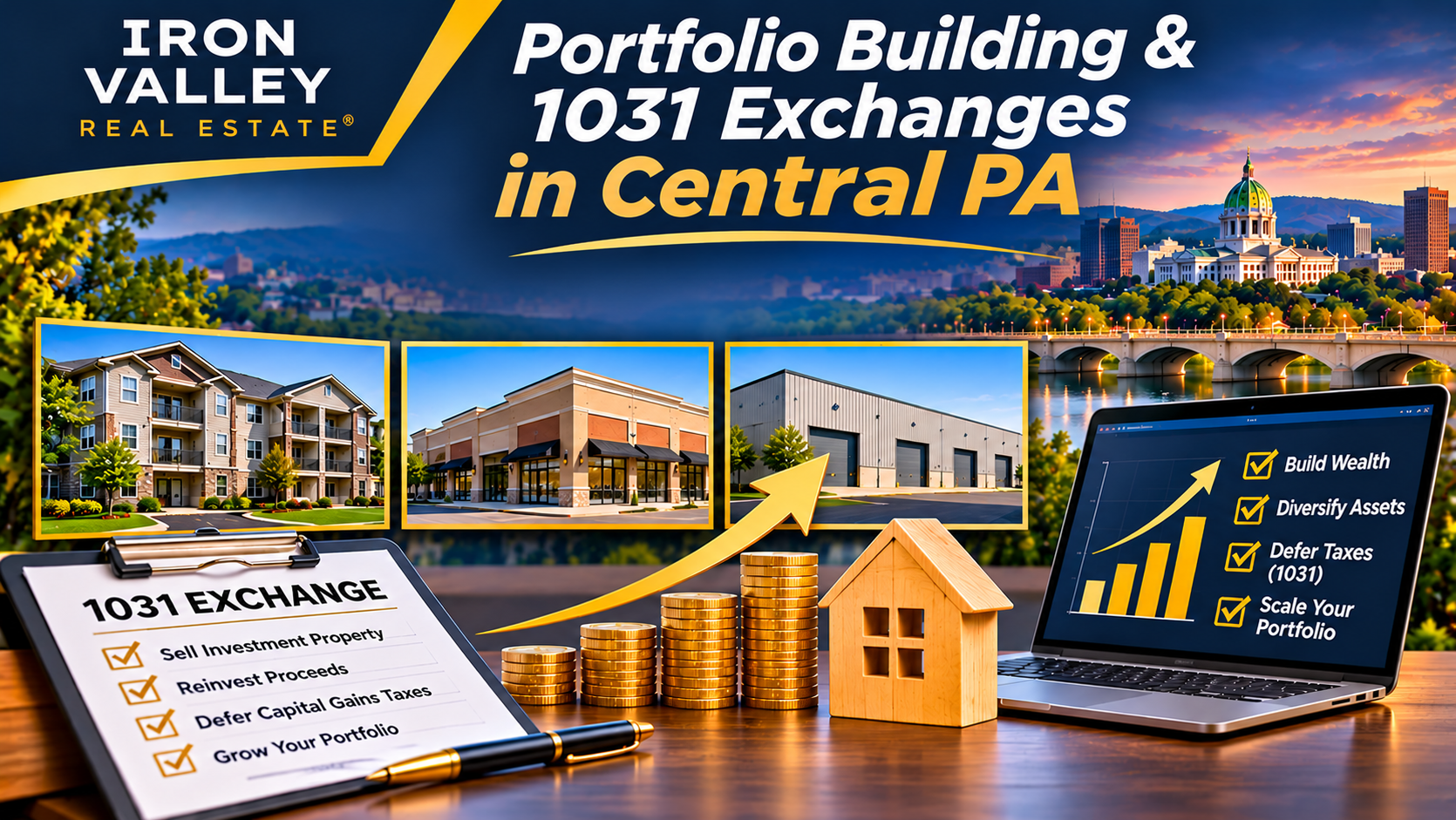
Once you've built a rental or two, the next chapter is portfolio strategy — growing deliberately, diversifying across submarkets and property types, and using tax-deferred 1031 exchanges to preserve equity when you sell and reinvest. Central Pennsylvania's stable, cash-flowing market and diversified submarkets make it a strong market for both portfolio building and exchange reinvestment. Here's a complete guide to constructing and scaling a 717 real estate portfolio, with the 1031 exchange rules, timelines, and strategies that keep your equity compounding tax-deferred.
What a portfolio strategy actually means.
A portfolio approach treats your real estate holdings as a coordinated collection rather than a series of one-off purchases. The goal is to balance cash flow, appreciation, and risk across multiple properties, submarkets, and property types — so the weakness of any single asset or submarket doesn't derail the whole. In Central PA, that might mean holding a cash-flowing duplex in Harrisburg city, an appreciation-oriented single-family rental in Mechanicsburg, a value-add flip in Camp Hill, and a turnkey rental in Carlisle — each playing a different role in the overall return. We help investors define the target mix (cash flow vs. appreciation, single-family vs. multifamily, geographic diversification) and then source the properties that fill each role.
The 1031 exchange: deferring taxes to preserve equity.
A Section 1031 exchange lets you sell an investment property and reinvest the proceeds into a like-kind investment property, deferring the capital gains tax and depreciation recapture that would otherwise be due at sale. For an investor with significant built-up equity, a 1031 exchange can preserve tens of thousands of dollars that would otherwise go to taxes — capital that stays compounding in real estate. The mechanics are strict: you must identify potential replacement properties within 45 days of closing your sale and close on the replacement within 180 days, and the proceeds must flow through a qualified intermediary — never to you directly. We work with investors and their qualified intermediaries to keep exchanges on track.
The 45-day identification rule and strategies.
The 45-day identification window is the tightest constraint in a 1031 exchange, and it's where most exchanges run into trouble. You may identify up to three properties of any value (the three-property rule), or more than three properties whose combined value doesn't exceed 200% of the relinquished property's value (the 200% rule), or any number of properties whose aggregate value doesn't exceed the relinquished property's value (the 95% rule). In practice, most investors use the three-property rule and identify three realistic replacement candidates — a primary target and two backups — so a failed contract on the first choice doesn't blow the exchange. We help investors line up replacement candidates before the relinquished property closes, so the 45-day clock starts with options already in view.
The 180-day closing window.
After identification, you have until the earlier of 180 days from the relinquished-property closing or your tax-return due date (including extensions) to close on the replacement property. In a market where well-priced Central PA properties move quickly, 180 days is usually enough — but it requires disciplined coordination between the sale, the identification, and the replacement acquisition. We help investors sequence these transactions so the timelines align and the exchange doesn't fail for a logistical reason.
Like-kind property and what qualifies.
'Like-kind' is broadly defined for real estate — virtually any investment real estate qualifies as like-kind to any other investment real estate, so you can exchange a single-family rental for a multifamily building, a commercial property for land, or a portfolio of properties for a single larger asset. The key restriction is that the property must be held for investment or productive use in a trade or business — not primarily for personal use or for immediate resale (which would be dealer property, not eligible for 1031). We help investors confirm that both the relinquished and replacement properties meet the held-for-investment standard.
Building a Central PA portfolio: submarket diversification.
Diversifying across Central PA submarkets reduces the risk that a single employer, school-district change, or local market shift hurts your whole portfolio. A balanced 717 portfolio might include a cash-flowing property in Harrisburg city (strong rents, higher taxes, more management), an appreciation-oriented rental in Mechanicsburg or Camp Hill (premium tenants, lower turnover), a value-add or turnkey rental in Carlisle (affordable entry, steady demand from Dickinson and the Army War College), and possibly a property in the Hershey or Lancaster markets for healthcare- and education-anchored demand. We help investors construct this mix deliberately rather than accumulating properties at random.
Scaling: from one property to a portfolio.
Scaling a portfolio changes the math on financing, management, and time. At one to three properties, self-management and conventional financing are usually workable. At four to ten, professional management and portfolio-lender relationships become higher-return. Beyond ten, entity structuring (LLCs, series LLCs), dedicated property management, and a more sophisticated financing strategy (DSCR loans, portfolio loans, commercial lines) typically make sense. We help investors think through these transitions before they hit them, so the portfolio scales smoothly rather than overwhelming the owner.
Streamlining: selling to consolidate or rebalance.
Portfolios aren't only about growth — sometimes the right move is to sell an underperforming or management-heavy property and reinvest the proceeds (via 1031) into a better-located or easier-to-manage asset. A tired rental in a high-turnover neighborhood might be better exchanged for a turnkey property in a premium suburb. A small multifamily building that's become a management burden might be exchanged for several single-family rentals that are easier to operate. We help investors identify the properties that are dragging on the portfolio's overall return and execute the sale and exchange that rebalances it.
The tax advantages beyond 1031.
Real estate offers several tax advantages that compound over a portfolio's life: depreciation (which shelters rental income from tax), the ability to refinance tax-free to pull equity out for reinvestment, step-up in basis at death (which can eliminate the deferred gains entirely for heirs), and opportunity-zone deferrals where applicable. We're not tax advisors, and we always recommend investors work with a CPA who understands real estate — but we help you see the strategic picture so your acquisitions and exchanges align with the tax plan your CPA recommends.
How we help portfolio and 1031 investors.
From sourcing the relinquished-property buyer to lining up replacement candidates before the 45-day clock starts, coordinating with your qualified intermediary and CPA, underwriting each acquisition against your portfolio's target return, and managing the acquisitions through settlement — we work as the strategic partner that keeps a portfolio growing or streamlining on plan. Aaron's mortgage-lending background and Josh's commercial and redevelopment experience give us the underwriting and transactional depth that multi-property and exchange investors need. And when you're ready to sell a property — a finished rehab, a turnkey rental, or a portfolio streamline — we list it with the same marketing firepower we bring to every Central PA home. Living in Central PA Team | Iron Valley Real Estate — Aaron & Josh — 717-REALTOR (717-732-5867).
Key Takeaways
- A portfolio strategy balances cash flow, appreciation, and risk across submarkets
- 1031 exchange defers capital gains and depreciation recapture at sale
- 45-day identification window is the tightest constraint — line up candidates early
- 180-day closing window — sequence sale, identification, and replacement carefully
- Like-kind is broad — any investment real estate qualifies for any other
- Diversify across Central PA submarkets to reduce single-market risk
- Scaling changes the math — management, financing, and entity structuring evolve
- Streamline by exchanging management-heavy assets for easier-to-operate ones
- Depreciation, refinance, and step-up in basis compound portfolio tax advantages
- Work with a qualified intermediary and a real-estate-savvy CPA — we coordinate