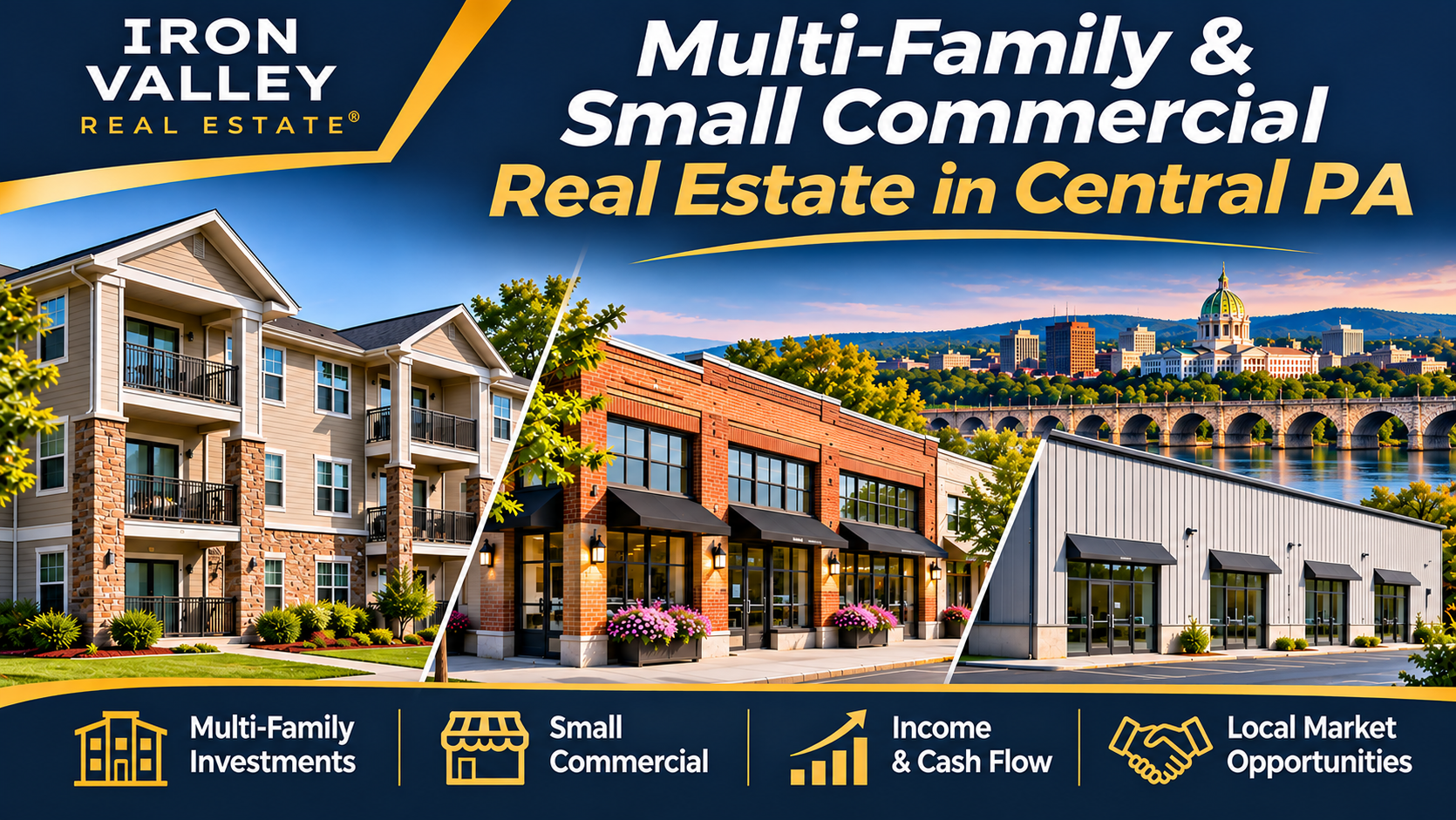
Multi-family and small commercial real estate is where many Central PA investors graduate from single-property rentals to scaled, income-producing portfolios. Duplexes, triplexes, four-plexes, and mixed-use properties across the Harrisburg-Carlisle corridor offer concentrated rental income, lower per-unit acquisition costs, and the operational efficiencies of managing multiple units under one roof. But they also demand sharper underwriting on cap rates, expense ratios, and financing. Here's a complete, numbers-driven guide to evaluating small multifamily and mixed-use in the 717 area code, with the latest 2026 benchmarks.
Why small multifamily appeals in Central PA.
The core advantage of a 2–4 unit property is concentration: multiple rent rolls under one roof, one roof to maintain, one location to manage, and lower per-unit acquisition cost than buying several single-family homes. In a market where single-family prices have risen meaningfully, a duplex or four-plex can deliver a higher overall cap rate and cash-on-cash return than the equivalent dollar amount spread across detached homes. The Harrisburg-Carlisle corridor has a steady but limited supply of small multifamily — much of it built in the mid-20th century in Harrisburg city, Camp Hill, Lemoyne, and the older boroughs — which means well-located units are genuinely scarce and tend to hold their value.
Cap rates and the numbers that define a multifamily deal.
A cap rate — net operating income (NOI) divided by purchase price — is the headline metric for income property, but it's only as reliable as the expense data behind it. In Central PA, small multifamily cap rates typically run in the 6–8.5% range depending on location, condition, and tenant profile, with stronger cap rates in Harrisburg city and the older boroughs and lower (but safer) cap rates in the premium suburbs. The mistake to avoid is trusting a listing's 'pro-forma cap rate,' which often understates vacancy, management, and capital expenditures. We rebuild the NOI from actual leases, actual tax bills, and realistic expense assumptions (vacancy 5–8%, repairs and maintenance 8–12% of gross rent, CapEx reserve 3–5% of gross rent, management 8–10%) before we trust any cap-rate figure.
Where small multifamily exists in the 717.
Harrisburg city has the largest concentration of duplexes, four-plexes, and small apartment buildings, often in Midtown, Uptown, and the established residential streets near the Capitol — strong rents and cap rates, but higher property taxes and more intensive management. Camp Hill, Lemoyne, and New Cumberland have a scattering of duplexes and four-plexes with premium tenant quality and lower turnover. Carlisle and the older Cumberland County boroughs offer duplexes and small mixed-use buildings at more attractive price points, supported by Dickinson College and Army War College rental demand. Mixed-use properties (street-level commercial with residential above) surface periodically in downtown Harrisburg, Camp Hill, Mechanicsburg, and Carlisle, and can be compelling when the commercial tenant is stable and the residential units are well-located.
Underwriting a multifamily property: the full expense model.
A real multifamily pro-forma accounts for every line item: gross potential rent (sum of all units at market rent), vacancy and credit loss (5–8%), property taxes (verified from the bill, not estimated), insurance (often higher per unit on multifamily), utilities paid by the owner (common in older buildings with master-metered electric or gas), water and sewer, trash, snow and lawn, common-area maintenance, repairs and maintenance (8–12% of EGI), capital expenditure reserve (3–5% of EGI), property management (8–10% of collected rent), and any licensing or inspection fees the municipality requires. Only after subtracting all of these do you have a defensible NOI — and only then does the cap rate mean anything.
Rent levels and rent growth by submarket.
Current 2026 market rents for two-bedroom units in Harrisburg city typically run $1,100–$1,500; in the East Shore suburbs, $1,300–$1,800; in Camp Hill and the West Shore boroughs, $1,300–$1,750; and in Mechanicsburg and the surrounding townships, $1,400–$1,900 for newer townhome-style units. Rent growth across the Harrisburg-Carlisle metro has been steady in the low-to-mid single digits annually, supported by the diversified employment base and limited new multifamily construction. We verify rents against current comparable leases — not the prior owner's rent roll, which may reflect below-market or legacy tenants — and we model the upside from bringing rents to market as part of the value-add thesis.
Financing small multifamily.
Financing a 2–4 unit residential property is similar to a single-family investment loan (20–25% down, slightly higher rate), while 5+ unit properties fall into commercial financing with different terms, higher down payments, and DSCR or commercial-loan qualification. Mixed-use properties typically require commercial financing regardless of unit count. Local community banks and portfolio lenders in Central PA are often the most flexible partners for small multifamily and mixed-use, and building a relationship with one early can pay off as you scale. We connect investors with lenders who understand Central PA income property and can model the real cost of capital — including the impact of rate and term on cash-on-cash return over the hold.
Value-add plays in small multifamily.
The most profitable small-multifamily acquisitions involve a value-add: a property with below-market rents, deferred maintenance, or a unit mix that can be improved. Bringing rents to market after lease turnover, renovating units to justify higher rents, separating master-metered utilities onto the tenants, and adding amenities (in-unit laundry, off-street parking, storage) can lift both NOI and the property's value — because multifamily value is driven by NOI, not just comparable sales. We help investors identify these value-add opportunities and underwrite the post-improvement NOI and the resulting refinance or sale value.
Property management at scale.
Once you own more than a few units, professional management becomes the higher-return choice. A good property manager handles tenant placement, rent collection, maintenance coordination, and turnover — and their fee (8–10% of collected rent) is often less than the time cost and vacancy drag of self-managing at scale. For mixed-use properties, management also involves the commercial tenant relationship and lease compliance, which adds a layer of complexity best handled by someone with experience. We help investors decide when to self-manage, when to hire, and how to vet a manager who knows the Central PA submarket.
The risks specific to multifamily and mixed-use.
Concentration risk — multiple units in one building means a single roof, one mechanical system, and one location; a major repair hits the whole property at once. Tenant concentration in small buildings — losing one of four tenants is a 25% vacancy, not a rounding error. Regulatory risk — some Central PA municipalities have rental licensing, inspection, and occupancy requirements that add cost and complexity. And mixed-use commercial risk — a vacant commercial space can sit empty for months and erode the entire property's NOI. We help investors weigh these risks against the higher returns and operational efficiencies that multifamily and mixed-use can deliver.
How we help multifamily and mixed-use investors.
Aaron's mortgage-lending background and Josh's commercial and redevelopment experience give us the underwriting toolkit — cap-rate analysis, expense modeling, financing strategy, and value-add identification — that small multifamily and mixed-use demand. We source on- and off-market 2–4 unit and mixed-use opportunities across the Harrisburg-Carlisle corridor, rebuild the NOI from real numbers, tour with an investor's eye for unit-mix and value-add potential, and coordinate the acquisition through settlement. And when you're ready to sell or refinance, we help you position the property to the buyer pool — other investors — who'll pay for the income stream you've built. Living in Central PA Team | Iron Valley Real Estate — Aaron & Josh — 717-REALTOR (717-732-5867).
Key Takeaways
- Small multifamily = concentrated rent rolls, lower per-unit cost, operational efficiency
- Central PA small-multifamily cap rates typically run 6–8.5% (rebuilt from real expenses)
- Never trust a listing's pro-forma cap rate — rebuild NOI from actual leases and bills
- Harrisburg city has the most supply; West Shore boroughs offer premium tenant quality
- Model vacancy 5–8%, R&M 8–12%, CapEx 3–5%, management 8–10% of collected rent
- 2–4 unit = residential financing; 5+ unit and mixed-use = commercial financing
- Value-add: bring rents to market, renovate units, separate utilities, add amenities
- Multifamily value is driven by NOI — improving NOI lifts the property's value
- Concentration and tenant-concentration risk are real — underwrite for them
- Local portfolio lenders are often the most flexible multifamily financing partners
Previous Article
Value-Add House Flips in Central PA: An Investor's Guide to Identifying, Underwriting, and Executing Profitable Renovations in the 717
Next Article
Portfolio Building & 1031 Exchanges in Central PA: An Investor's Guide to Scaling, Diversifying, and Deferring Taxes on Real Estate in the 717